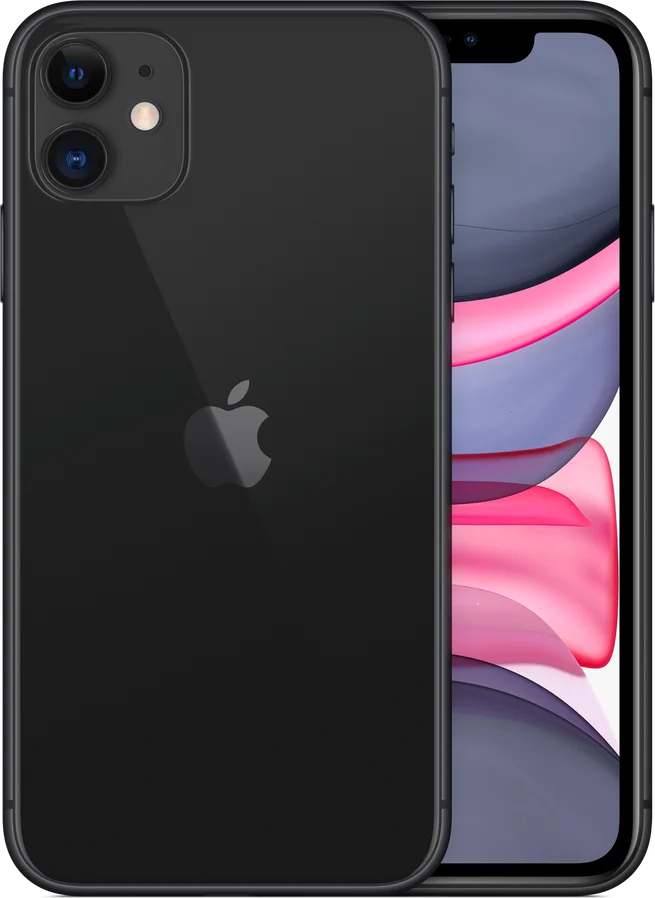
HomePhonesAppleApple iPhone 11
Apple iPhone 11
Apple

Apple iPhone 11

7.9/10 UpPhone score

The Apple iPhone 11 remains a well-rounded choice with dual 12 MP cameras, Apple A13 Bionic performance, and IP68 water resistance — all at a compelling price that makes iOS more accessible than ever.

Verified for iOS
Chip
Apple A13 Bionic (7nm)
The verdict, & two little voices

Should you actually get the Apple iPhone 11?

The editor weighs in — flanked by the optimist on her shoulder and the cynic on the other.
UP
Our takeEditorial
The Apple iPhone 11 at $199 represents one of the most efficient entries into the iOS ecosystem available today. The A13 Bionic chip still delivers performance that rivals or beats modern mid-range processors, iOS update support continues to extend the phone's useful lifespan well beyond what Android phones from the same era can claim, and the dual 12 MP camera system with Night Mode, Portrait Mode, and 4K video remains genuinely capable. The IP68 water resistance, Face ID, Qi wireless charging, and stereo speakers fill out a feature list that punches above the price.

The trade-offs are real but manageable: no headphone jack, Lightning rather than USB-C, a 60Hz display, and 64 GB of non-expandable storage that requires disciplined management. For users who can work within those constraints — and for iOS first-timers who want an affordable on-ramp to Apple's ecosystem — the iPhone 11 at current pricing is hard to argue with. It's not the newest or most capable iPhone, but it's a well-designed phone with staying power, and that matters at any price.

UpPhone Team
The Optimist
“THE A13 BIONIC IS STILL IN THERE AND IT'S STILL MAGNIFICENT! The Apple iPhone 11 at $199 is basically highway robbery except Apple is the one being robbed and they don't even know it! Two 12 megapixel cameras! Face ID! IP68 water resistance! Wi-Fi 6! WIRELESS CHARGING! All the greatest hits of Apple engineering crammed into a phone you can buy for less than a decent concert ticket! The Liquid Retina display is gorgeous, the stereo speakers hit different, and the A13 is STILL faster than chips shipping in phones that cost twice as much today. iOS support that just keeps going and going. Night Mode that makes your midnight photos look like you hired a professional photographer. This phone aged like fine wine and it now costs like a decent bottle of said wine. INCREDIBLE deal. INCREDIBLE phone. Buy one immediately!”
— the angel on your shoulder
The Cynic
“Ah, the iPhone 11 — Apple's 2019 greatest hit, now available at the price of a nostalgic compromise. Yes, the A13 is still technically impressive, but let's have an honest conversation about what $199 actually buys you here: a phone without a headphone jack (bold in 2019, merely tedious now), a Lightning cable in a USB-C world (a true act of defiance against all that is rational), and a 60Hz display in 2025 when my refrigerator probably refreshes faster than this screen. The battery isn't going to embarrass you, but it's not going to impress anyone either. Sixty-four gigabytes with no expandability means you'll spend a portion of every week deleting photos to make room for more photos. The stereo speakers are nice. I'll give them the stereo speakers. Everything else about recommending a six-year-old phone as "a good deal" requires a very specific kind of optimism I cannot provide.”
— the devil in your other ear
Our take

The Apple iPhone 11 remains a well-rounded choice with dual 12 MP cameras, Apple A13 Bionic performance, and IP68 water resistance — all at a compelling price that makes iOS more accessible than ever.

The Apple iPhone 11 landed in September 2019 as Apple's mainstream iPhone, and its combination of powerful hardware, excellent cameras, and iOS longevity has kept it relevant years after launch. Powered by the Apple A13 Bionic chip — built on a 7 nm+ process — the iPhone 11 delivers performance that still holds up exceptionally well for everyday tasks, gaming, and demanding apps. Apple's software support record means iPhone 11 users continue to receive iOS updates long after competitors' phones of the same era have been left behind.

The 6.1-inch Liquid Retina IPS LCD display with 828 x 1792 resolution and 326 PPI provides sharp, accurate visuals at 625 nits brightness, making it legible in direct sunlight. The dual 12 MP rear camera system — comprising a wide and ultra-wide lens — represents a genuine leap in mobile photography versatility, while the 12 MP front camera handles Face ID authentication and video calls with equal assurance. IP68 water resistance rated to 2 meters for 30 minutes gives the iPhone 11 meaningful durability for everyday life.

At current market pricing starting at $199 (refurbished) to $199 new, the iPhone 11 represents one of the most efficient entry points into Apple's ecosystem. With Face ID, Qi wireless charging, Wi-Fi 6, Bluetooth 5.0, NFC, and stereo speakers packed into a 150.9 x 75.7 x 8.3mm chassis weighing just 194 grams, the iPhone 11 punches well above its current price in nearly every category.

What we love
  • Apple A13 Bionic delivers class-leading performance that still outpaces many newer mid-range Android chips
  • Dual 12 MP camera system with wide + ultra-wide lenses for genuine photography versatility
  • IP68 water resistance rated to 2 meters for 30 minutes
  • Face ID biometric authentication is fast, secure, and reliable in most lighting conditions
  • Qi wireless charging supported alongside wired PD2.0 fast charging (50% in 30 minutes)
  • Apple's long iOS update support cycle extends the phone's useful lifespan significantly
  • Stereo speakers provide noticeably better audio than single-speaker competitors
What we don't
  • No headphone jack requires an adapter or wireless earbuds
  • Lightning connector rather than USB-C creates friction in mixed-cable households
  • 60Hz display lacks the smoothness of 90Hz and 120Hz screens on newer phones
  • 64 GB base storage is tight for heavy media users with no expandability
  • Battery life is adequate but trails current-generation smartphones

Full specifications

Performance
ChipApple A13 Bionic (7nm)
RAM4 GB
Storage64 GB
OSiOS
Camera
VideoYes
Design
Form factorSlate
Connectivity
NFCYes
USBUSB 2.0 (480 Mbps)
SIMeSIM only
FAQ

Frequently asked questions about the Apple iPhone 11

What kind of display does the Apple iPhone 11 have?

The iPhone 11 features a 6.1-inch Liquid Retina IPS LCD display running at 828 x 1792 resolution — that's 326 pixels per inch, the same pixel density Apple has used on non-Pro iPhones for years because it genuinely looks sharp in everyday use. Brightness tops out at 625 nits, which is sufficient for outdoor viewing in moderate sunlight, though it's not quite at the level of OLED panels in direct bright sun.

Color accuracy on the Liquid Retina display is excellent thanks to Apple's True Tone technology, which adjusts white balance to match ambient lighting. The 60Hz refresh rate is the most notable display limitation compared to newer phones — scrolling and animations feel slightly less silky than 90Hz or 120Hz panels — but for most users, the display's color quality and brightness more than compensate for the lower refresh rate.

What kind of camera does the Apple iPhone 11 have?

The iPhone 11's dual camera system consists of two 12 MP lenses: a main wide-angle camera and an ultra-wide camera, giving you significantly more compositional flexibility than a single-lens setup. Apple's computational photography pipeline — Smart HDR, Night Mode, and Deep Fusion — produces well-exposed, detailed photos across a wide range of lighting conditions. Video recording supports 4K, and Apple's video stabilization makes handheld footage impressively smooth.

The 12 MP TrueDepth front camera is built specifically around Face ID, which means it captures precise facial geometry data while also delivering sharp selfies and supporting Portrait Mode. Front camera video is smooth and sharp for video calls and social media content. The iPhone 11 camera system continues to be a benchmark for what smartphone photography looked like at a critical moment in the industry's evolution, and the results still hold up favorably against much newer mid-range competition.

What is the battery life of the Apple iPhone 11?

The iPhone 11 comes equipped with a battery designed for all-day use, and Apple's fast-charging support via PD2.0 means you can get to 50% in about 30 minutes when using a compatible charger. Wireless Qi charging is also supported for overnight top-ups or desk charging convenience.

Real-world battery life on the iPhone 11 is solid for everyday use — streaming, calls, social media, and light gaming will typically carry most users through a full day. Heavy users, particularly those who lean on mobile gaming or prolonged video recording, may find themselves reaching for a charger before the end of a demanding day. The battery performance is honest and reliable within those expectations.

What processor does the Apple iPhone 11 use?

The Apple A13 Bionic chip — manufactured on a 7 nm+ process — was the fastest mobile processor available when the iPhone 11 launched in 2019, and it has aged with remarkable grace. Paired with 4 GB of RAM, the A13 handles everything from complex photography processing and augmented reality apps to demanding games and video editing without breaking a sweat even years after release.

What makes the A13 Bionic particularly noteworthy is Apple's tight integration between hardware and software. iOS is optimized specifically for Apple silicon, meaning the A13 delivers efficient, consistent performance across all system functions. The A13's Neural Engine enables on-device machine learning for features like computational photography, Face ID processing, and Siri, all handled locally without cloud dependency. At its current pricing, you're getting a processor that outperforms many mid-range chips shipping in phones released years later.

How much storage does the Apple iPhone 11 have?

The iPhone 11 64 GB model gives you a workable amount of on-device storage, though it's the configuration where storage management becomes part of the ownership experience. iCloud integration helps extend effective storage by keeping photos and documents in the cloud while freeing up local space, but the 64 GB ceiling is real — heavy app users, large local photo libraries, and offline media downloaders will feel constrained.

There is no expandable storage on the iPhone 11 — no microSD slot and no way to add capacity after purchase. For users who stream rather than download, keep a lean app library, and rely on iCloud Photo Library, 64 GB is very manageable. For power users who want to keep everything local, the constraint is worth weighing carefully before choosing the base storage tier.

What kind of speakers does the Apple iPhone 11 have?

The iPhone 11 features stereo speakers — a bottom-firing speaker and an earpiece speaker working together to deliver a wider, more immersive soundstage than a single speaker can produce. For a phone in this class and era, the stereo separation is noticeable and appreciated during video streaming, music listening, and speakerphone calls.

Audio quality from the iPhone 11's speakers is clean and reasonably loud, with decent mid-range presence and minimal distortion at high volumes. Bass is limited, as is typical for phone speakers, but the overall tuning favors intelligibility and clarity over bass-heavy boom. For a device at its current price point, the stereo speaker setup is a genuine advantage over many competing options.

Does the Apple iPhone 11 support fingerprint or face unlock?

The iPhone 11 uses Face ID — Apple's 3D facial recognition system built on the TrueDepth camera array — as its primary biometric authentication method. Face ID works by projecting 30,000 infrared dots onto your face and reading the resulting depth map, creating a facial model that's stored securely in the device's Secure Enclave. This approach makes Face ID significantly more secure than 2D facial recognition systems used by many competing Android devices.

In everyday use, Face ID unlocks the iPhone 11 in about a second across most lighting conditions — it works in the dark, in bright sunlight, and with glasses or hats. The one limitation is mask usage, which partially obstructs facial recognition. However, iOS has introduced Unlock with Apple Watch for masked environments. Face ID also authenticates Apple Pay, App Store purchases, and password autofill, making it deeply integrated into the iPhone 11 experience.

Is the Apple iPhone 11 water-resistant?

The iPhone 11 carries an IP68 rating, which means it's rated dust-tight and water resistant to immersion up to 2 meters for 30 minutes under controlled lab conditions. In practical terms, this means the iPhone 11 can survive rain, splashes, accidental drops in shallow water, and brief submersion without immediate damage.

It's worth noting that IP ratings are tested with fresh water under laboratory conditions, and the water resistance degrades over time as seals age. Apple also does not cover water damage under its standard warranty. The IP68 rating on the iPhone 11 provides genuine peace of mind for everyday accidents — rain, drinks, sink splashes — but it's not an invitation to use the phone for underwater photography. Treat the rating as meaningful protection for realistic real-world mishaps rather than a waterproofing certification.

Related phones

Also consider

Apple iPhone 17e 128 GB
from $16.67/mo
Apple iPhone 17 256 GB
from $23.03/mo
Apple iPhone 17 Pro 256 GB
from $13.06/mo