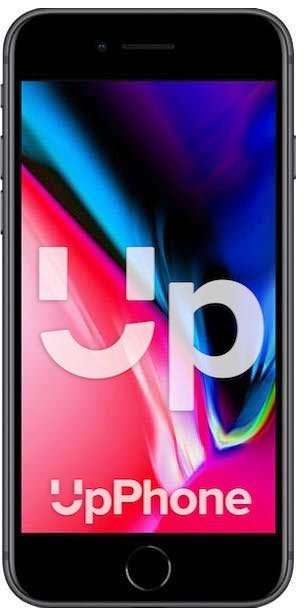
HomePhonesAppleApple iPhone 8
Apple iPhone 8
Space Gray
Apple

Apple iPhone 8

7.0/10 UpPhone score

The Apple iPhone 8 64 GB delivers the iconic Apple experience with Touch ID, wireless charging, and the powerful A11 Bionic chip in a compact 4.7-inch form factor that remains a compelling choice for those who prefer a smaller, lighter iPhone.

Verified for iOS
Storage
Screen
4.7"
Chip
Apple A11 Bionic (10 nm)
Camera
12 MP
Water
IP67 dust/water resistant (up to 1m for 30 min)
The verdict, & two little voices

Should you actually get the Apple iPhone 8?

The editor weighs in — flanked by the optimist on her shoulder and the cynic on the other.
UP
Our takeEditorial
The Apple iPhone 8 64GB is a well-built, capable smartphone from Apple's design peak that continues to deliver a solid experience for moderate users. The A11 Bionic chip keeps it feeling responsive, the compact form factor has real fans, and the IP67 rating, wireless charging, and Touch ID are all genuine quality-of-life features. For users who prefer Apple's ecosystem and want a compact smartphone experience, the iPhone 8 scratches that itch effectively.

The main consideration is the refurbished pricing and the iOS support situation. At $649.99 to $749.99 for a refurbished unit, buyers should weigh whether the investment makes sense versus newer models with ongoing support. If the price point works and the compact form factor is important to you, the iPhone 8 is a well-made choice. If longevity and the latest iOS features matter, investing a bit more in a newer supported model is the wiser long-term play.

UpPhone Team
The Optimist
“The iPhone 8 is one of the most underrated smartphones ever made, and the refurbished market has only made that case stronger. The A11 Bionic chip is genuinely fast — it handled augmented reality, machine learning, and 4K video when it launched and continues to handle everyday tasks without breaking a sweat. The compact 4.7-inch form factor is a breath of fresh air in an era of oversized slabs, and Touch ID is frankly faster and more reliable in many real-world situations than Face ID under masks or sunglasses. Add IP67 water resistance, wireless Qi charging, stereo speakers, and Apple's legendary long-term software ecosystem support, and you have a phone that delivers a pure, uncompromising Apple experience in a hand-friendly package. For anyone who values compact design and proven performance over the latest specs, the iPhone 8 remains a genuinely excellent phone.”
— the angel on your shoulder
The Cynic
“Let's be honest about what the iPhone 8 is in 2024: an aging device that Apple has stopped supporting with the latest iOS versions. iOS 16 is the end of the road, which means no iOS 17 features, potential security vulnerability gaps going forward, and an increasing number of apps that will start dropping support for older iOS versions over time. The single rear camera is fine but cannot hold a candle to modern multi-lens systems, the Lightning connector is a step behind the USB-C future, and the 2GB of RAM means multitasking can feel constrained compared to modern phones. At the refurbished prices on offer — $649.99 to $749.99 — you are spending a significant amount on a phone that is already past its software support peak. There are newer, supported iPhones available at competitive prices that will serve you better long-term.”
— the devil in your other ear
Our take

The Apple iPhone 8 64 GB delivers the iconic Apple experience with Touch ID, wireless charging, and the powerful A11 Bionic chip in a compact 4.7-inch form factor that remains a compelling choice for those who prefer a smaller, lighter iPhone.

Released in September 2017, the Apple iPhone 8 64 GB represents Apple's final evolution of the classic iPhone design before the all-screen era began with the iPhone X. Built around a 4.7-inch Retina IPS LCD display and powered by the A11 Bionic chipset — the same chip that launched in the iPhone X that year — the iPhone 8 combines a familiar, hand-friendly design with genuinely impressive performance. The glass back introduced with this model enabled wireless Qi charging, a first for the standard iPhone lineup.

Under the hood, the Apple A11 Bionic (10nm) is a remarkable processor that delivered flagship-class performance at launch and continues to handle everyday tasks, iOS updates, and the vast majority of apps with ease. Paired with 2GB of RAM and 64GB of storage, the iPhone 8 runs iOS efficiently with characteristic Apple smoothness, benefiting from Apple's tight hardware-software integration. The 12-megapixel rear camera, while a single lens, captures impressive images through Apple's computational photography pipeline, including 4K video recording and optical image stabilization.

With IP67 dust and water resistance, Touch ID fingerprint authentication, Apple Pay support, Bluetooth 5.0, and dual-band Wi-Fi, the iPhone 8 64GB is a feature-complete smartphone that carries Apple's hallmarks of reliability and ecosystem integration. Available as a refurbished device from T-Mobile at select retailers, it offers entry into the Apple ecosystem at a fraction of current flagship prices.

What we love
  • Apple A11 Bionic (10nm) chip delivers excellent performance for its era and beyond
  • IP67 dust and water resistance for protection against splashes and brief immersion
  • Wireless Qi charging plus fast wired charging (50% in 30 minutes) via PD 2.0
  • Touch ID fingerprint sensor is fast, reliable, and works with Apple Pay
  • 12MP rear camera with optical image stabilization and 4K video recording
  • Compact 4.7-inch form factor comfortable for one-handed use
  • Stereo speakers for fuller audio experience
  • Bluetooth 5.0 and dual-band Wi-Fi 802.11 a/b/g/n/ac
What we don't
  • No headphone jack — requires Lightning adapter or wireless headphones
  • Lightning connector rather than USB-C limits compatibility with modern accessories
  • 2GB RAM can feel limiting with many apps open simultaneously
  • Single rear camera lacks the versatility of modern multi-lens systems
  • LCD display cannot match the contrast or brightness of modern OLED panels
  • Software update support has ended with iOS 16 being the final version

Full specifications

Display
Size4.7"
TypeRetina IPS LCD, 625 nits (typ)
Resolution750 x 1334 px
PPI326
Performance
ChipApple A11 Bionic (10 nm)
RAM2 GB
Storage64 GB
OSiOS
Cellular4G LTE
Camera
Rear camera12 MP
Front camera7 MP
VideoYes
Battery
Wireless charging15W wired, PD2.0, 50% in 30 min | Wireless (Qi)
Design
Dimensions138.4 x 67.3 x 7.3 mm
Weight148
ColorsSpace Gray
Water ratingIP67 dust/water resistant (up to 1m for 30 min)
Form factorSlate
Connectivity
Wi-FiWi-Fi 802.11 a/b/g/n/ac, dual-band, hotspot
BluetoothYes, 5.0
NFCYes
USBLightning, USB 2.0
Networks4G: 1, 2, 3, 4, 5, 7, 8, 12, 13, 17, 18, 19, 20, 25, 26, 28, 29, 30, 34, 38, 39, 40, 41, 66 | 3G: HSDPA 850 / 900 / 1700(AWS) / 1900 / 2100 | 2G: GSM 850 / 900 / 1800 / 1900
SIMNano-SIM
FAQ

Frequently asked questions about the Apple iPhone 8

What kind of display does the Apple iPhone 8 have?

The iPhone 8 features a 4.7-inch Retina IPS LCD display at a resolution of 750 x 1334 pixels (326 PPI) with a typical brightness of 625 nits. The display is sharp, color accurate, and exceptionally readable in daylight thanks to Apple's True Tone-adjacent calibration and solid peak brightness. While it does not offer the deep blacks and infinite contrast ratio of an OLED panel, the IPS LCD delivers natural, accurate colors that many users prefer for everyday viewing.

At 326 PPI, text is crisp and icons are sharp to the human eye at normal viewing distances — Apple's Retina threshold. The compact 4.7-inch size makes the display easy to reach across for one-handed use, a trade-off that many users with smaller hands actively prefer over larger modern smartphones. The display is protected by reinforced glass and supports Apple's True Tone technology on supported iOS versions for automatic color temperature adjustment.

What kind of camera does the Apple iPhone 8 have?

The iPhone 8 carries a single 12-megapixel rear camera with an f/1.8 aperture, optical image stabilization, and Apple's image signal processor from the A11 Bionic chip. The result is a camera that punches above its megapixel count through excellent computational photography — smart HDR, accurate color science, and reliable autofocus across a wide range of lighting conditions. Optical image stabilization reduces blur from hand movement, particularly useful in lower-light environments.

The front-facing 7-megapixel camera captures detailed selfies with Portrait Mode support for bokeh-style background blur on compatible iOS versions. Video recording tops out at 4K at 30fps on the rear camera and 1080p at 30fps on the front. While it lacks the ultra-wide and telephoto lenses of more recent iPhones, the iPhone 8's single camera system remains a capable, reliable performer for everyday photography and video capture.

What is the battery life of the Apple iPhone 8?

The iPhone 8's battery life is adequate for moderate daily use. Apple's efficient A11 Bionic chip and iOS's tight power management contribute to reasonable longevity, though by modern smartphone standards the battery capacity is modest. Fast charging via USB Power Delivery (PD 2.0) at 15W can bring the phone to 50% charge in approximately 30 minutes, and Qi wireless charging is supported for cable-free top-ups.

Heavy users may find they need to charge during the day, particularly if using demanding apps, GPS navigation, or streaming video. Under typical mixed use — calls, messaging, social media, and some video — the iPhone 8 generally provides enough power for a full day. The battery is now several years old in units sold as refurbished, and actual capacity will depend on the battery health of the specific device purchased.

What processor does the Apple iPhone 8 use?

The Apple A11 Bionic (10nm) is one of the most impressive chips Apple has ever produced relative to the competition it faced at launch, and it remains a capable processor years later. The six-core CPU (two performance cores, four efficiency cores) handles multitasking, app launching, and demanding workloads with the smoothness that Apple's hardware-software integration enables. The integrated Apple-designed GPU handles graphics rendering efficiently, supporting smooth gameplay and video playback.

A key feature of the A11 Bionic is its Neural Engine — Apple's first dedicated machine learning processor — which enables on-device AI tasks including Face ID (on the iPhone X) and computational photography features in the camera system. For the iPhone 8, the Neural Engine enhances camera processing and Siri responses. In practical terms, the A11 Bionic makes the iPhone 8 feel current and responsive for the vast majority of everyday smartphone tasks even years after its release.

How much storage does the Apple iPhone 8 have?

The 64GB storage configuration provides comfortable room for apps, photos, and media for most users. Apple's efficient file system and app management keep the 64GB feeling spacious for typical use, though heavy media creators or users who download large apps and games may find themselves managing storage more actively. The iPhone 8 does not support expandable storage via microSD, making the base 64GB the available allocation on this model. iCloud storage can supplement onboard capacity for photos and documents with a paid subscription.

What kind of speakers does the Apple iPhone 8 have?

The iPhone 8 features stereo speakers — a bottom-firing speaker and the earpiece speaker — which together produce a notably wider soundstage than a single mono speaker. Audio quality is clear and well-tuned by Apple's audio processing, making music, podcasts, and video audio enjoyable for casual listening. Volume levels are adequate for most environments. The stereo configuration is particularly appreciated for video content and speakerphone calls, where the spatial separation adds clarity and presence to the audio.

Does the Apple iPhone 8 support fingerprint or face unlock?

The iPhone 8 uses Touch ID — Apple's capacitive fingerprint sensor embedded in the home button — for biometric authentication. Touch ID on the iPhone 8 is fast, reliable, and integrates deeply with iOS for device unlock, Apple Pay contactless payments, and App Store purchases. The sensor is positioned on the home button, which doubles as a hardware navigation button, making authentication a natural part of the interaction flow. Touch ID remains a beloved authentication method for many users who prefer it to the face-scanning approach of Face ID introduced later in the iPhone X.

Is the Apple iPhone 8 water-resistant?

The iPhone 8 carries an IP67 certification, meaning it is rated for dust resistance and water resistance at up to 1 meter of depth for up to 30 minutes. This provides meaningful protection against accidental splashes, rain exposure, and brief submersion — enough to survive a drop in a sink or a caught-in-the-rain scenario. It is important to note that IP67 is not a permanent or unconditional rating; damage from liquid exposure is not covered by Apple's standard warranty, and the seals can degrade over time, particularly in older or refurbished units. Users should treat the water resistance as a safety net rather than an invitation for deliberate exposure.

Related phones

Also consider

Apple iPhone 17e 128 GB
from $16.67/mo
Apple iPhone 17 256 GB
from $23.03/mo
Apple iPhone 17 Pro 256 GB
from $13.06/mo