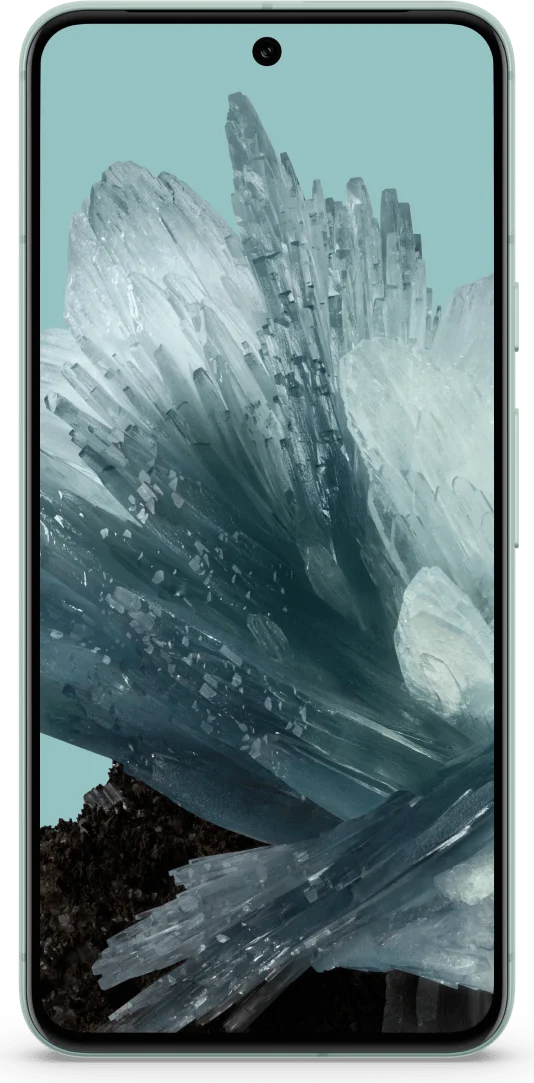
The Google Pixel 8 combines the custom Tensor G3 chip, a stunning 120Hz OLED display, and Google's most advanced computational photography to deliver an AI-powered flagship experience with seven years of guaranteed software support.
The Google Pixel 8 represents a pivotal moment in Google's smartphone journey. Launched in October 2023 alongside the Pixel 8 Pro, it introduced the second-generation Tensor G3 chip — a custom silicon designed from the ground up by Google to accelerate AI and machine learning tasks on-device. The result is a phone where the camera, voice assistant, and software features feel genuinely smarter and more capable than anything achieved through general-purpose mobile chipsets alone.
At 6.2 inches with a 1080 x 2400 OLED panel running at 120Hz with HDR10+ certification and 2000 nits peak brightness, the Pixel 8's display is genuinely impressive. The 428 PPI pixel density renders text and images with exceptional sharpness, and the panel's brightness makes it readable in direct sunlight — a practical advantage that matters in everyday use. The compact footprint, at 150.5mm tall and 8.9mm thin, makes it one of the more comfortable flagships to hold and pocket.
Google's commitment to seven years of OS updates and security patches — an industry-leading guarantee — transforms the Pixel 8's value proposition significantly. While competitors provide three to four years of software support, Pixel 8 owners are assured of receiving Android updates through 2030, making it one of the most future-proof smartphones available at any price. Paired with IP68 water resistance, 50MP main camera, stereo speakers, Wi-Fi 7 support, and NFC, the Pixel 8 at $799.99 makes a strong case against significantly more expensive alternatives.
The Pixel 8 features a 6.2-inch OLED panel with a 1080 x 2400 resolution at 428 PPI, delivering crisp and detailed imagery. The 120Hz adaptive refresh rate ensures smooth scrolling and responsive touch interaction throughout the interface. HDR10+ support enables expanded dynamic range for compatible content, and the 2000 nits peak brightness makes the display legible in direct sunlight — a practical advantage over many competitors that struggle in bright outdoor conditions.
Google's display calibration delivers accurate colour reproduction, and the OLED technology provides true blacks and excellent contrast ratios for media consumption. The compact 6.2-inch diagonal keeps the Pixel 8 manageable for one-handed use while still delivering a premium visual experience.
The Pixel 8's camera system centres on a 50MP primary wide-angle sensor paired with a 12MP ultrawide lens, complemented by a 10.5MP autofocus front camera. Google's computational photography — powered by the Tensor G3's dedicated image signal processor and TPU — continues to set the standard for smartphone photography. Features like Photo Unblur, Magic Eraser, Best Take, and Night Sight showcase what on-device AI processing unlocks beyond raw megapixel counts.
Video recording is supported with stabilisation and quality optimisation enabled by Tensor G3 processing. The ultrawide lens adds compositional flexibility for landscapes and confined spaces, and the autofocus front camera ensures sharp, well-focused selfies and video calls. Google's HDR+ computational pipeline automatically manages dynamic range, delivering well-exposed images in high-contrast scenes where conventional camera systems struggle.
The Pixel 8 supports 27W wired charging with PD3.0 and PPS protocols, reaching 50% charge in approximately 30 minutes according to Google's specifications. Wireless charging at 18W supports convenient cable-free top-ups, and reverse wireless charging enables the Pixel 8 to charge compatible accessories like Pixel Buds directly from its back. Bypass charging allows the phone to run directly from a power source during gaming or demanding tasks, reducing heat generation and battery wear during extended sessions.
Google's Tensor G3 chip is fabricated on Samsung's 4nm process and represents Google's third generation of custom silicon. Rather than competing on raw CPU speed, Tensor G3 is engineered to accelerate AI and machine learning inference tasks on-device — enabling camera features, speech recognition, and language processing that outpace what cloud-dependent or general-purpose chipsets can deliver. For everyday tasks, multimedia, and camera processing, Tensor G3 delivers excellent performance with thermal efficiency that supports sustained workloads.
The Pixel 8 ships with 128GB of UFS internal storage, providing a solid base for apps, photos, and media. There is no microSD card slot, making the 128GB capacity the device's permanent ceiling for local storage. Google One cloud storage integration makes this less constraining for users who back up photos and videos automatically, but heavy local media libraries will require disciplined management. The UFS storage delivers fast read and write speeds for app performance and file operations.
The Pixel 8 features stereo speakers — a meaningful audio upgrade over single-driver alternatives. The speaker system delivers spatial, room-filling sound for media consumption, video calls, and music playback without headphones. Google tunes its Pixel audio output for clear vocal reproduction and balanced frequency response. Combined with the OLED display and HDR10+ capabilities, the stereo speaker setup makes the Pixel 8 a genuinely enjoyable device for watching content on the go.
The Pixel 8 includes an in-display fingerprint sensor for secure and convenient biometric authentication. Google's fingerprint implementation has improved consistently across Pixel generations, delivering fast and reliable unlocking in daily use. The sensor integrates with Android's biometric API for app authentication, payment confirmation, and device unlocking. Face unlock provides an additional contactless authentication option for situations where fingerprint access is inconvenient.
The Google Pixel 8 carries an IP68 dust and water resistance rating, certified for immersion in up to 1.5 metres of fresh water for 30 minutes. This is the highest standard IP water resistance available on consumer smartphones, providing genuine protection against submersion, rain, and accidental drops in water. IP68 certification covers both water and dust ingress, sealing the device against particulate matter that can damage internal components over time. The IP68 rating applies to fresh water; exposure to chlorinated, salt, or soapy water may reduce protection effectiveness.